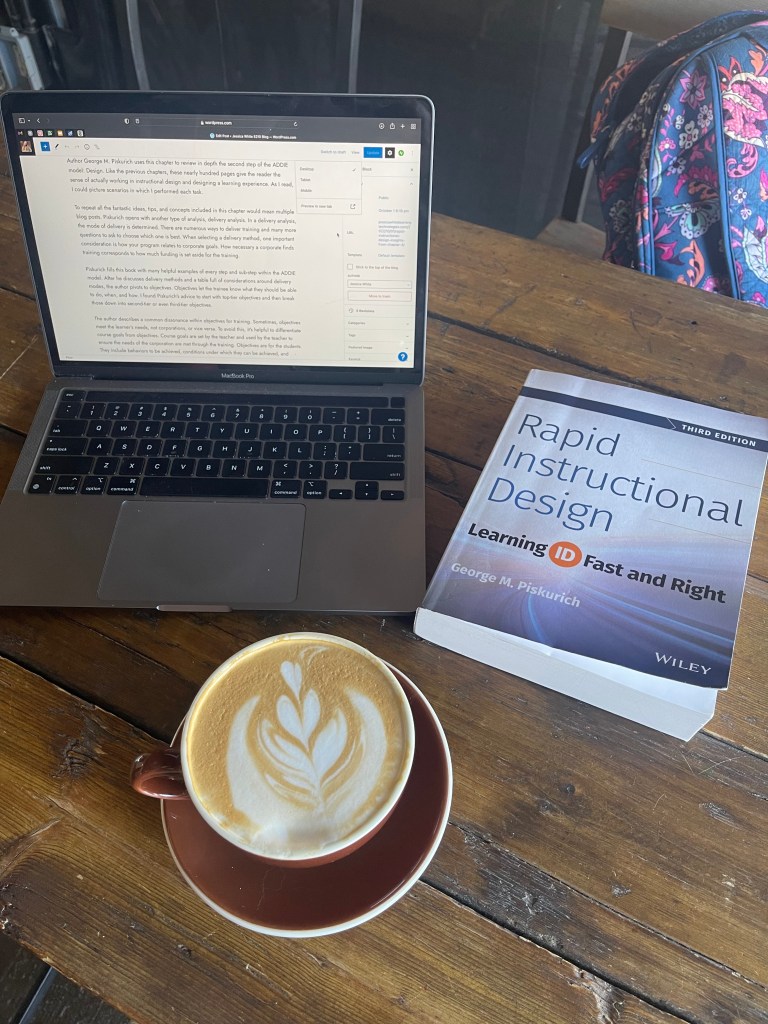
In Chapter 5, Doing it Right: Development of Rapid Instructional Design, author George Piskurich offers a how-to guide for developing a training session or learning experience. Development is an exciting stage because you can see your learning experience as a whole by the end. It is complete, but that job isn’t done yet. It will need to be implemented and evaluated, then eventually, improved.
But before anyone can learn from or evaluate your lesson, the work of development lies ahead. Piskurich recommends that you step back and look at your whole training plan to determine what will be necessary for trainer and trainee success. There are many types of training, such as classroom, on-the-job, self-instruction, and more. When you have determined your training needs, you must decide how to produce it. This will largely depend on the training type and delivery method.
One big difference between my current role as a classroom teacher and my future career as an instructional designer, or training coordinator, is that in the classroom, I develop lessons, and then I teach them. In corporate training, I will often create learning experiences that someone else must deliver. Because we will likely not be there when our pieces of training occur, trainers must have all the tools they need to train successfully.
To best prepare your trainer, a facilitator guide should be designed. This guide should mirror the training in scope and sequence. It should include objectives, guiding questions, objectives, assessments, and possible areas where you foresee confusion. If you are not going to deliver the training, you should include as many helpful details as possible without overwhelming the trainer. Finally, the facilitator guide is also a piece of instructional design, and therefore the principles of design should be followed to help trainers interpret your guide.
A good training session includes opportunities for trainees to interact and engage. I appreciate the long list of possible training activities that would work in several different training sessions. A few of these stood out to me as being highly effective. For instance, Piskurich mentions an activity he calls “Critical Incident,” in which trainees are given an incomplete problem and must analyze the case and ask the right questions to find a solution.
I am currently working on an instructional design project. I have several activities planned for this learning experience, each with its own media type. Including examples of this media in the training guide can be helpful. In my project, I am using a form of slides, Nearpod, which will share information regarding my objectives and assess their grasp of the information before the lesson moves forward. I also include many images, both historical drawings, and modern computer models, to drive home the evolution of the atomic model. The instructor I am working with has indicated that the most significant learning gap is that students struggle to grasp why the model changes over time.
 Jessica White's Learning Technology Blog & Portfolio